Our Blog


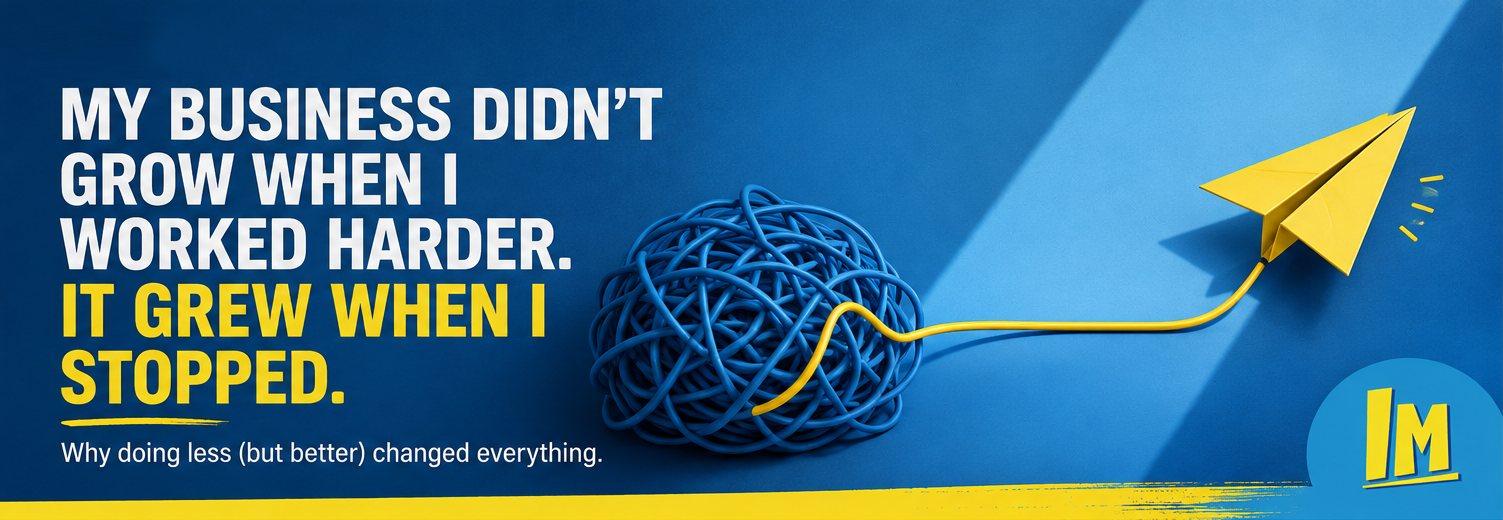
A counterintuitive lesson that took me years - and one burnout - to finally learn.
There's a story we tell ourselves about success.
It goes like this: if things aren't working, work harder. Wake up earlier. Add
another offer.
Say yes to more clients. Build another funnel. Hire someone. Launch a new product. Post
more content. Send more emails.
Do. More.
It's the default setting of almost every ambitious founder I've ever met. It was
certainly
mine.
And for a long time, I believed it completely.
A few years into running my business, I was putting in more
hours than ever. I had five
service offerings. A growing team. A content calendar with three posts a week. A
pipeline
full of leads. Partnerships in the works.
On paper, it looked like momentum.
In reality, I was drowning.
My team was confused about priorities. My clients were getting average work instead of
exceptional work. I was constantly in reactive mode - answering messages, fighting small
fires, sitting in meetings that didn't move the needle. Revenue had plateaued.
Worse, my
energy had collapsed.
I was doing everything. And doing none of it well.
The harder I pushed, the more resistance I felt. Like driving with the handbrake on.
Burnout has a way of forcing the conversations you've
been avoiding.
After a particularly brutal quarter - missed targets, a key client churned, two team
members burned out alongside me - I sat down and asked a question I had never seriously
asked before:
Not what should be working. Not what I had invested in. Not
what looked good in a pitch
deck. What was actually, measurably, undeniably working?
The answer was uncomfortable. Out of five service offerings, one was responsible for
nearly
80% of revenue and nearly 100% of our best client relationships. One content format -
long-form articles - drove almost all our inbound leads. One type of client - mid-sized
B2B
companies going through a transition - got outsized results and referred others.
Everything else? Noise.
So I did something that felt deeply counterintuitive at the time.
I cut.
ASimplification isn't laziness. It isn't quitting.
It isn't settling.
It is the disciplined, sometimes painful act of removing everything that dilutes your
best
work.
Here's what it looked like for me in practice:
I cut four of my five service offerings. We went all-in on the one
that worked. No more
"but
maybe someone will want this." No more hedging. One offer, priced properly,
delivered
exceptionally well.
I stopped posting on three platforms and focused on one. Instead of
mediocre presence
everywhere, I chose depth on LinkedIn. The reach didn't collapse - it grew, because
the
content got better when I wasn't spreading myself thin.
I got radically specific about who I serve. I stopped saying yes to
every lead that
could pay. I
started saying yes only to the clients where I knew - genuinely knew - we could deliver
something remarkable. The qualification conversation that used to feel like lost revenue
started feeling like the most valuable conversation in the process.
I eliminated meetings that existed out of habit. A weekly team
meeting that had drifted
into a 90-minute catch-up became a 20-minute focused standup. I got hours back every
week.
The business didn't implode. Within three months, revenue had climbed. Within six,
it had
grown more than in the previous two years combined.
Here's the uncomfortable truth about why we overcomplicate things.
Complexity feels like progress. Multiple offers feel like resilience. A packed calendar
feels
like demand. Saying yes feels like opportunity. More features, more options, more
content
- it all feels like building something.
But feeling productive and being productive are not the same thing.
Complexity is also a hiding place. When you have ten things in motion, it's easy to
avoid
confronting whether any single one of them is truly excellent. You can always blame the
lack
of results on the other nine things you're juggling. You never have to face the
question: is
my best work actually good enough to stand alone?
Simplification removes that hiding place. It forces you to bet on your strongest hand.
That's
terrifying - and it's exactly why most people don't do it.
This isn't just a personal observation. The pattern holds across businesses of every
size.
Steve Jobs returned to Apple in 1997 to find a company with dozens of product lines,
licensing deals, and initiatives running simultaneously. The company was haemorrhaging
money. His first move wasn't to add more. It was to cut the product line from over
350
items to just four. Four. That clarity - and the focus it enabled - became the
foundation
for one of the greatest corporate turnarounds in history.
Warren Buffett, when asked about success, didn't talk about doing more. He talked
about
his "25-5 rule" - write down your 25 most important goals, identify the top 5,
and treat the
remaining 20 not as secondary priorities, but as things to actively avoid. The things
that
didn't make the top five weren't low priorities. They were distractions.
In his book Essentialism, Greg McKeown puts it plainly: "The way of the
Essentialist means
living by design, not by default." The undisciplined pursuit of more gets in the
way of the
disciplined pursuit of better.
If you're building something right now and it feels harder than it should, try this
exercise.
Sit with these three questions honestly - not the answers you wish were true, but the
ones
that are:
1. What is the one thing in your business that, if you removed everything else,
you
could
still build something exceptional around?
This is your core. Everything that isn't this is a candidate for cutting.
2. Where are you doing adequate work when you could be doing extraordinary
work?
Adequate work spread across ten things will always lose to extraordinary work
focused on
one. Where is your energy getting diluted?
3. What are you saying yes to out of fear rather than alignment?
Fear of missing out. Fear of disappointing someone. Fear of having fewer options.
Fear
is not
a strategy. Audit your commitments and ask which ones you'd choose again today,
with
fresh eyes.
More is not more. In business - as in most things - more is often just more noise.
The businesses that scale aren't usually the ones doing the most things. They're
the ones
doing the right things, relentlessly and exceptionally well. They've made peace with
the
trade-off: depth over breadth, mastery over variety, clarity over optionality.
There is a version of your business that is leaner, sharper, and more profitable than
the one
you're running right now. It doesn't require more hours. It requires more
honesty about
what to stop.
The market doesn't reward effort. It rewards excellence. And excellence requires
focus.
You don't have to blow up everything tomorrow. Simplification is a practice, not a
single
event.
Start small. Pick one thing this week to stop doing. One commitment to decline. One
offer to
sunset. One meeting to cancel. One platform to step back from.
Notice what happens. Not just to your results - but to your energy, your attention, your
quality of work.
Then do it again.
Bit by bit, you will find the version of your business that doesn't just survive the
grind - but
thrives without it.
The hardest thing I ever did for my business was give it permission to be smaller. What
it
became, as a result, was so much better.
What's one thing in your business you've been holding on to that you
know, deep
down,
needs to go? I'd love to hear it.
