Our Blog


The views in this article draw on the latest industry
research and my 30+ years working
with various brands. Let's get into it.
We are living in the golden age of brand video. More video content is being produced
right now than at any other moment in marketing history. Brands are spending billions.
Teams are grinding on scripts, storyboards, and production timelines. And yet, when
researchers actually measure what viewers remember - the results are nothing short of
humbling.
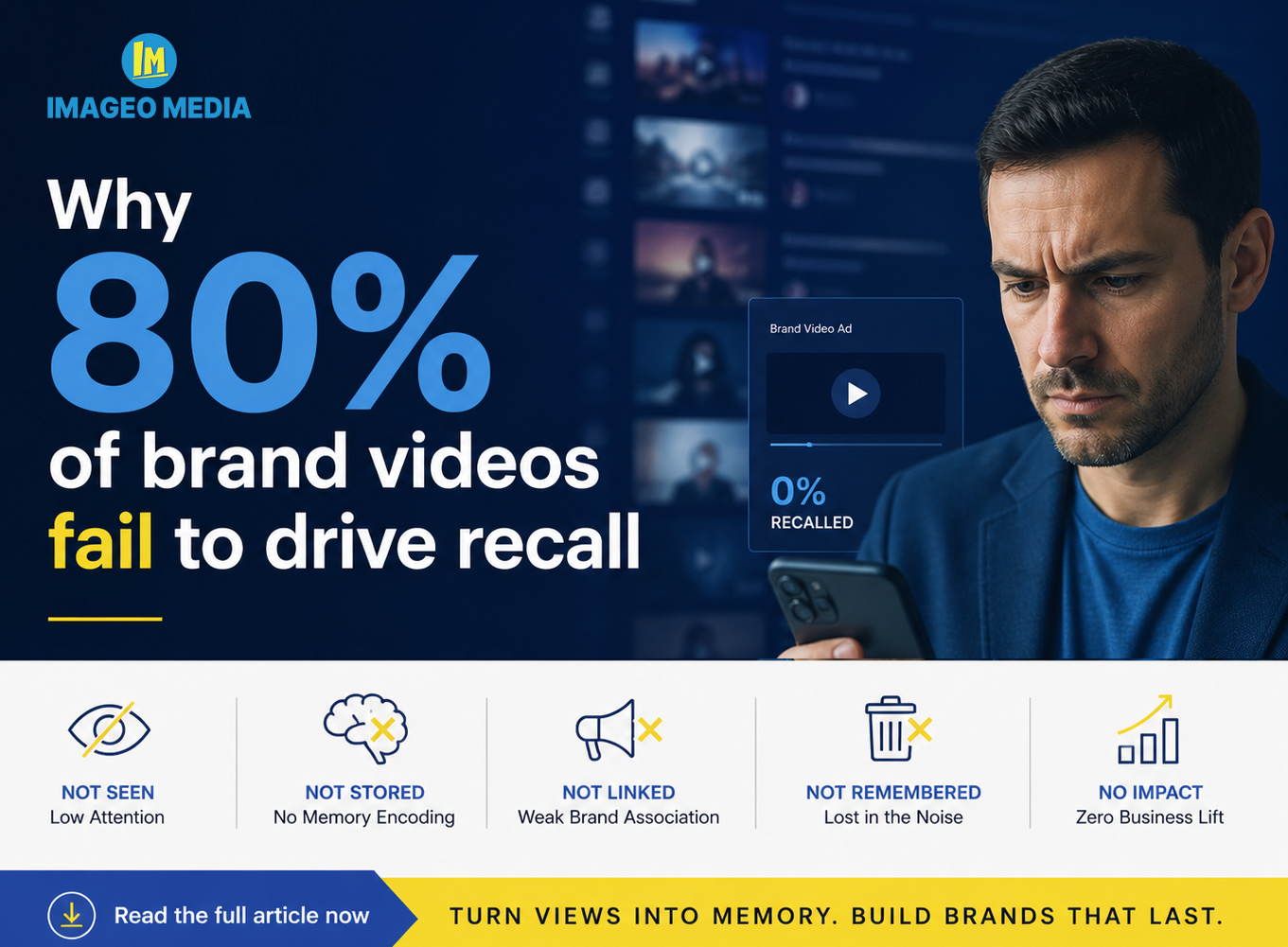
A landmark LinkedIn B2B Institute and Media Science study found that 81% of B2B
video ads fail to register with viewers - meaning they generate neither
adequate
attention nor
brand recall. A separate RK Swamy–Hansa Research study of 3,000 consumers found that
despite people watching an average of 2.17 hours of video daily, they recalled only 1.5
brands on average - and out of 600+ brands studied, only 11 crossed the 3% recall
threshold. Let that sink in: 600 brands, invisible.
The spend is real. The views are real. The recall? Mostly fiction.
So, what's going wrong? Why brand videos fail to leave any fingerprint on the human
brain?
Here's the most ironic failure mode in brand video: the
brand isn't actually in the
video. Or rather, it shows up so late, so small, or so timidly that the audience never
makes the connection. You craft a beautiful two-minute emotional narrative, and the logo
appears in the last three seconds like a shy teenager at prom.
Research confirms this is catastrophic. In the LinkedIn/Media Science study, of
participants who did see a B2B ad, only 36% could correctly identify the brand. The
creative existed. The brand integration did not. If viewers can't attribute your story
to your company, you haven't made an ad - you've made a donation to ambient content.
The fix isn't slapping your logo on every frame. It's building your brand identity into
the narrative - through visual language, tone, character, and recurring sensory triggers
that make the brand inseparable from the story.
As Jay Baer once said: you can either be
disproportionately
emotional, or massively
relevant - and relevancy is the killer app. Most brand videos are neither.
They're
polished, they're expensive, and they're profoundly generic.
Research by Prezi found that 55% of consumers forget branded content primarily
because
it's irrelevant to them. Another 69% of digital video viewers report that
the ads shown
to them feel irrelevant to their lives. When content doesn't connect to a viewer's
actual world - their job, their problems, their aspirations - the brain literally does
not flag it as worth storing. Memory is a filing system. Irrelevant content never gets
filed.
The uncomfortable truth for marketers is this: a video that feels personally irrelevant
to the viewer is worse than no video at all, because it actively trains the audience to
tune you out. You spend money teaching people to ignore you.
The metrics dashboard is lying to you. View count,
completion rate, click-through - these
are attention metrics. They tell you someone's eyes were pointed in your direction for a
moment. They tell you nothing about whether your brand moved from short-term stimulus to
long-term memory structure.
Neuroscience research published in Frontiers in Psychology found strong correlations
between emotional brain response and long-term ad recall - meaning the feeling a video
creates is the mechanism of memory, not the number of seconds someone watched. Yet most
brand video briefs are optimized around engagement metrics and production aesthetics,
not emotional architecture.
The LAMBDA memorability dataset - the first large-scale study on long-term ad
memorability, covering 1,749 participants and 2,205 ads across 276 brands - reinforces
this: long-term memorability requires structural design, not just
compelling visuals.
You have to engineer recall; not hope it happens.
Here's the brutal math of modern attention: your video
doesn't just compete against your
competitor's video. It competes against every notification, meme, news headline, family
photo, and cat video in the known universe. The average person is drowning in content,
and their brain has evolved a ruthless defense mechanism - aggressive forgetting.
Prezi's research found that 80% of consumers forget branded content within just
3 days.
Not 80% of bad content. 80% of all branded content. One of the top reasons cited?
"Too
much content to retain" - reported by 30% of respondents. You're not just
fighting for
attention; you're fighting against the architecture of human cognition.
The implication is stark: frequency without distinctiveness is waste. Posting more
videos of the same forgettable type doesn't build memory - it builds immunity.
A lot of brand videos feel emotional in the moment —
sweeping music, cinematic shots, a
dog, maybe a sunrise. But emotion alone doesn't create durable memory.
Narrative does.
Emotion attached to a story does. There's a profound difference between a video that
makes someone feel something and a video that gives them a story to retell.
Research on viral video advertising found that entertainment value drives
sharing, but
social value drives brand equity. In other words, the videos that get
passed around
aren't necessarily the ones building your brand in memory. The content that actually
sticks is content that tells the audience something new - rated as the most memorable
content type, ahead of emotional stories and product information.
The great brand videos aren't just felt - they're retold. They give the viewer a
surprising idea, a useful reframe, or a story worth repeating at dinner. That's what
earns a place in memory.
Here's something most video marketers don't know:
video is
increasingly consumed as
audio. With 50% of viewers muting ads they can't skip, and
streaming-as-background-sound
now accounting for 35% of all listening time, your visual-only brand strategy has a
massive blind spot.
Research by Audion found that combining digital audio within video content drives
76%
brand recall versus lower rates for visual-only approaches, with 80%
message accuracy
when audio is intentionally layered. Your brand voice, sonic logo, music choice, and
narration tone are recall mechanisms - not production details.
If your video only works with the sound on, it doesn't work.
The brands that beat the recall gap share a handful of non-negotiable habits:
The video revolution has democratized production but not impact. Anyone can make a
beautiful video today. Very few brands know how to make a memorable one. And in a world
where viewers recall only 1.5 brands from hours of daily watching, the gap between
beautiful and memorable is worth everything.
Stop making videos people watch. Start making videos people remember.
